-
ART ONO 2026
SEOUL, SOUTH KOREA
APRIL 3-5, 2026
-
Makasiini Contemporary is thrilled to exhibit at ART OnO 2026 in Seoul,
marking our first ever year at one of Asia's most interesting art fairs showing emerging AND MID-CAREER artists.
We invite collectors, curators and art enthusiasts to visit us at booth 209, SETEC, Seoul.
-
Daniel Arsham
-
Born 1980 I Lives and works in New York NY, USADaniel Arsham creates interdisciplinary art firmly situated in the world. As the artist himself states, “I make things I want to see exist in the world.” Arsham’s sculptures often resemble eroded artifacts or fragmented monuments, blurring the boundaries between art, architecture and design.Arsham refers to his practice as “fictional archaeology,” creating works that appear to belong to our material history but are in fact visually tied to the recent past or the present day. Drawing from the narrative traditions of classical sculpture, Arsham produces figures that unexpectedly merge ancient iconography with contemporary composition and appearance. These reinterpreted images – like a bust of a woman wearing a Roman palla or a hoodie – present a tension between history and the present, as the art historical canon is used to depict objects drawn from popular culture.As materials, Arsham uses geological substances such as volcanic ash and selenite, which create the impression the works being millennia-old archaeological discoveries. Ideologically, Arsham presents objects that endure time—transcending or bypassing it altogether. Objects covered in ash appear long-lost, and their “rediscovery” brings a sense of wonder to the viewer. These works seem preserved like time capsules, simultaneously fragile and monumental. The monochromatic nature of his works; a restrained colour palette, reinforces the illusion of archaeological remnants, further distancing the objects from the contemporary moment.Arsham graduated from The Cooper Union for the Advancement of Science and Art in New York, where he studied fine arts with a strong emphasis on architecture and engineering. Arsham has co-founded the exhibition space The House, and with Alex Mustonen, the design studio Snarkitecture, a practice that seeks to merge design, art and architecture by working within and transforming existing structures. Arsham has served as a stage designer for the Merce Cunningham Dance Company, and collaborated with brands such as Dior, Adidas, and Byredo. His works are included in the collections of institutions such as the Centre Pompidou, Musée Guimet, the DIOR Collection, and the Walker Art Center. He was awarded the Gelman Trust Fellowship in 2003 as well as the GNMH Award.
-
Jorge Galindo
-
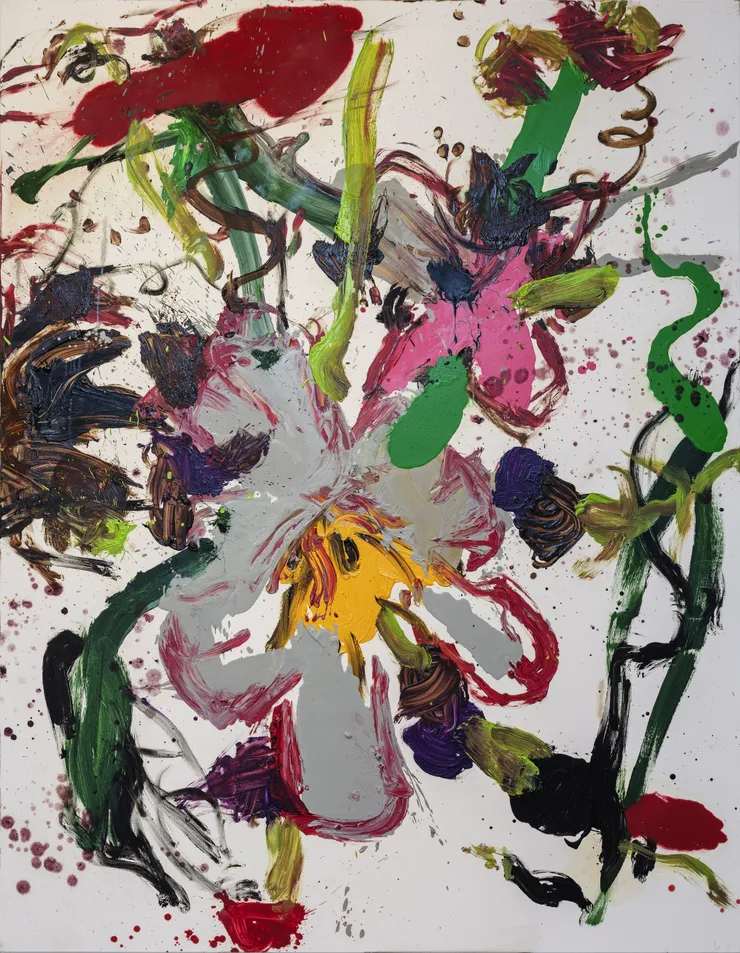
Born 1965 | Lives and works in Porto, PortugalThe lush, bravura paintings of Spanish artist Jorge Galindo move between gestural abstraction and figuration, incorporating elements of collage. The painter, who lives and works in Porto, Portugal, has described his expressionistic style as “dirty pop.” In Galindo’s hands, this idiom brings together various chapters of twentieth-century painting—the collage of synthetic cubism, the aggressive and immediate brushwork of Willem de Kooning, and the commodity critique and juxtaposition of Haim Steinbach—as well as the Renaissance genre of still life. In the early 1990s, Galindo studied with Julian Schnabel in the Círculo de Bellas Artes workshops in Madrid; there, he made paintings inspired by Dadaists, especially Hannah Höch, as well as paintings that integrated photomontages of images sourced from midcentury printed materials. In 1996, he introduced swaths of colored and patterned fabrics into his abstractions with his Patchwork paintings; and his first figurative series, Pintura animal (1999), features kitsch-like renderings of hybrid canine creatures bathed in dramatic splatters and drips of paint.In 2009, Galindo embarked on the floral paintings for which he is best known. Inspired by Henri Fantin-Latour’s painting A Basket of Roses as it appeared on the cover of New Order’s 1983 album Power, Corruption & Lies, he began painting flowers based on images sourced from antique postcards he’d found at flea markets. Ten years later, he returned to the subject matter for the Flores de periferia paintings, a collaboration with filmmaker Pedro Almodóvar. These works are based on a series of small format photographs Almodóvar took of “peripheral” flowers—those that grew in the margins of train tracks—arranged in vases. Galindo’s recent work conjoins and layers commercial, mechanically reproduced images of flowers—in the form of sampled wallpaper or silkscreened ephemera—with expressive impressions of blooms painted in confident gestural brushstrokes. Brimming with painterly incident, these canvases engage myriad styles and methods to emphasize the resounding potential of the blossom to signify as well as its unflagging affinity for metaphor.
-
-
-
Rafa Macarrón
-
Born 1981 I Lives and works in Madrid, Spain
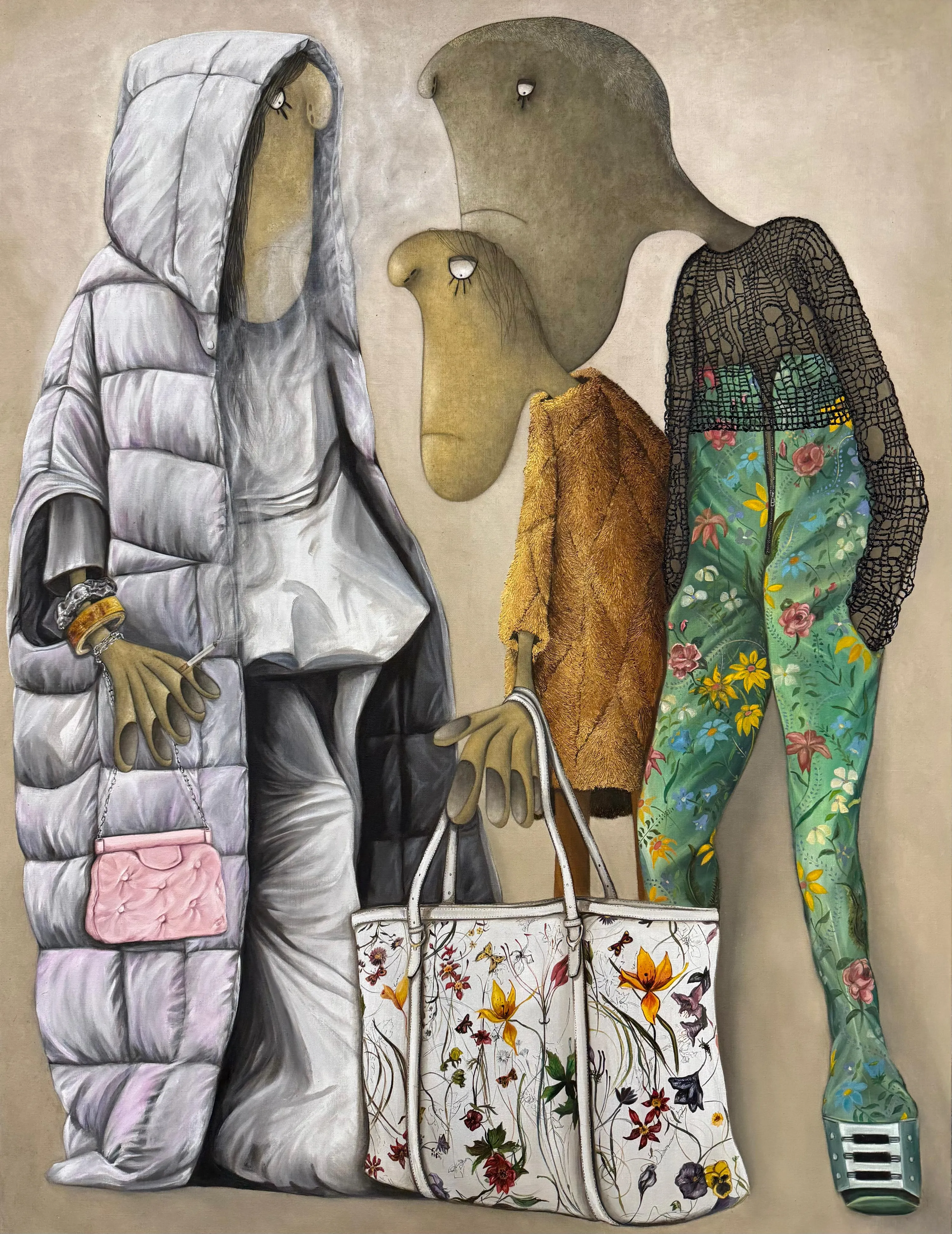
The Spanish artist Rafa Macarrón displays anatomical figures with their stretched forms and extended proportions. The paintings are full of representations, which are peculiarly scaled. Macarrón’s visual language of human condition is based on reality, yet in a surreal way.By his other profession Macarrón is a physiotherapist. His understanding of the human form is therefore detailed and measured. However, from the knowledge of anatomy and bodily mechanics, Macarrón creates a versatile revelation of themes. The exaggerated silhouettes inhabit imaginative spaces and present a narrativeness, that still carries the truth. The paintings also depict elaborate fashion, such as seemingly designer handbags and clothes. Macarrón’s figures reflect the life we all live, although in a fantastical way.The artist’s recurring lines and shapes are carefully constructed. The works contain elements of intensity and surprise, and Macarrón’s recognizable expressiveness is unfolding a world of unique vision. The entity becomes a scene of anatomical reflections. Symbolism and surrealism coexist, containing subtle social commentary and psychological insight. The compositions of the works are rich and carefully considered; the artist gives each figure their own meaning. Distorted shapes are symbolising the challenge of the so-called normal. None of the figures are conventional, but all are captivating. Together, these works create a world that is at once surreal and intimate, where transformations clarify vulnerability and emotion, and imagination serves a method for understanding what it means to be human.Rafa Macarrón’s works have been exhibited at e.g. CAC, Centro de Arte Contemporáneo de Málaga, Museo de Arte Contemporáneo, Alicante, Museo DA2, Salamanca and Museo de Arte Contemporáneo, Elche, in Spain, and Universidad de Puebla, Mexico. Macarrón’s works are in the collections of Hudson Valley Center for Contemporary Art, Peekskill, New York, Fundación BMW, Spain, and Fundación Vivanco, La Rioja, among others. He has been awarded ARCOmadrid Best Artist in 2013. -

Rafa Macarrón
Untitled, 2026Oil on linen
183 x 140 cm
72 x 55.12 inches -
Jason Martin
-
Born 1970 I Lives and works in London, UK and PortugalJason Martin interrogates the fundamental elements of painting with bold, minimal abstractions that approach sculptural dimension. The British artist, who divides his time between London and Lisbon, garnered international attention with his participation in the controversial 1997 exhibition Sensation: Young British Artists from the Saatchi Collectionat the Royal Academy of Arts in London. There, his work stood apart from that of the other YBAs presented because, rather than discarding genre or employing shock tactics, his paintings evince a deep engagement with modernist questions of medium specificity.As a student at Goldsmiths in the early 1990s, Martin began to manipulate skins of striated oil paint or acrylic gel with a bespoke comb-like tool. He has refined this technique over the course of his career, developing complex modes of processing paint that allow control and chance to together structure his surfaces.Working with pure pigment, graphite, acrylic, andoil paint on aluminum, stainless steel, or Plexiglas grounds, he reduces the terms of his explorationto color, texture, and medium, finding abundant compositional possibilities within these constraints. The resulting paintings offer subtle, modulating gradients or intensely saturated monochromes, in which dense and gestural brushstrokes project out from the substrate in dramatic relief.Across his paintings, Martin achieves a vivid physicality. Grooves, ridges, crags, and accretions index the artist’s movement over the surface of the work, tracing a choreography of artistic production while suggesting atmospheric topographies. While his exhaustive and iterative exploration of the materiality of paint recalls the ethos of Robert Ryman, his engagement with the way shadow and light play across the surface of his paintings evokes the concerns of Group Zero. “I've always viewed myself as a landscape painter dressed up as an abstractionist,” the artist explains. “When you look at my works, you gaze into this imaginary space beyond and project associations from your own mental landscape on it. To me figuration and abstraction are beautifully intertwined.”
-
Jason Martin
Untitled (Phthalo blue), 2025Mixed media on aluminium
86 x 70 x 10 cm
33.89 x 27.56 x 3.94 inches -
Einari Hyvönen
-
Born 1989 | Lives and works in Helsinki, Finland
Einari Hyvönen’s post-digital artworks are marked by the contrast between their light, happy visual motifs and gloomy content. But tragicomic humour makes it easier to cope with even difficult issues, such as the ending of a relationship, the loss of a loved one, or environmental catastrophe. “I present these subjects and images in ways that are intended to help viewers to overcome shame by dealing with them through laughter, and to remember that everyone else goes through similar grief at some point in their lives,” he says.
Hyvönen manages to present even dark experiences in a new way without diminishing them yet transforming the way we encounter them. Humour curves around sorrow; lightness brushes against fear. Through these tensions, a new kind of clarity emerges – one that recognizes the weight of what has been lived but resists the heaviness that can silence. In the paintings, the surfaces resemble plastic and foil – glossy, fragile, and appealingly artificial – blending with organic forms and creating a tension between the natural and the synthetic. The visual language is deliberately layered and provocative. Recognizable, partly exaggerated figures – both mythical and drawn from popular culture – lure the viewer closer and act as gateways to more complex questions about power, responsibility and the possibility of change. Symbols such as the Doomsday Clock’s hand nearing midnight or the family tree address vulnerability and the potential for renewal at the same time.
The works trace moments of transformation – gentle and violent, continuous and fleeting. Hyvönen uses references to popular culture to make his art more accessible, while, at the same time, prioritising artistic value and skill. The sketch phase is done with 3D modelling and image-editing software, and the resultant nostalgic digital images juxtaposed with traditional painting deliberately create an odd, skewed atmosphere.
Hyvönen gained his Master’s degree from the Academy of Fine Arts, University of the Arts Helsinki in 2021 and has since taken part in solo and collective exhibitions in Finland and further afield in Europe. Hyvönen’s art is in the collections of the Finnish State, Kiasma, Oulu and Tampere Art Museums, and elsewhere.
-
Einari Hyvönen
For You in the Glow, 2025Oil, acrylic and airbrush on canvas
81,5 x 120 cm
32.1 x 47.25 inches -
Roope Itälinna
-
Born 1990 I Lives and works in Turku, FinlandRoope Itälinna’s oil and acrylic paintings deceive the eye of the viewer with their acute attention to detail. At first glance, they appear to be photographs. Itälinna explores themes such as escapism, as seen through the world of electronic music. The theme and the excecution also contain elements of surrealism.
In the paintings, Itälinna’s own experiences and profound impressions from the past are mingled with imaginary situations and settings. The atmosphere is not unambiguous, nor is it easy to tell from looking at the characters whether they are bored or euphoric. Whether they are seeking ecstatic liberation, harmless hedonism amid the fog from smoke machines and the brightly coloured lights, or is it a survival mechanism – the ultimate reason remains obscure. The paintings invite the viewer into moments where reality and imagination intersect, encouraging prolonged observation and reflection. Expressing a psychological and emotional reality, Itälinna extends the meaning of his works beyond the limits of visible reality.
The images range from tightly cropped close-ups to gloomy, spacious halls, and seemingly endless spaces. In Itälinna’s works the meticulous depiction of the objects – borrowed from photorealism, with even the tiniest details registered on the canvas – is combined with understated, minimalist picture surfaces. The choice of idea for a new work and its composition on canvas is usually the result of extended deliberation, sometimes, the right picture snapped in an instant is enough to get him started. The painting process takes a lot of time, demanding intense concentration and a protracted working process.Itälinna has studied in the Turku Arts Academy as well as the University of Turku. Itälinna has exhibited at e.g. Untitled Miami with Makasiini Contemporary, Besides numerous private collections, Itälinna’s works are in the collection of Kiasma, Museum of Contemporary Art. Itälinna is the Finnish Young Artist of the Year 2026. -
Roope Itälinna
Room two, 2026Oil and acrylic on canvas
125 x 125 cm
49.22 x 49.22 inches -
Harri Puro
-
Born 1989 I Lives and works in Turku, Finland
Harri Puro’s expressive paintings constantly move around in the ground between figurative and abstract. The sense of figures in a landscape emerging from lived environments echo influences from art history and the visual language of impressionism, post-impressionism and genre painting.
Puro’s imagery draws from the artist’s personal archives – moments lived, close friendships, and a tightly knit community. His practice engages with the contradictions inherent in common life, addressing themes such as person’s mind in thought; people, situations, shapes and colours, rather than depicting actual reality. In his works the external and internal worlds intertwine, bringing a psychological dimension to the paintings. This also gives him a greater freedom, e.g. in allowing things to be illogical or unfinished. Elements can fall apart or still be in the process of forming, and the artist can play with paint and materiality. There is a strong sense of overlapping times and places, and of various in-between states: between sleep and wakefulness, between outer and inner reality, between the personal and the collective. It is often unclear whether the space depicted is an interior or an exterior. A certain sense of absurdity and humour is also something Puro consciously tries to bring more into his work, as these are qualities that feel intrinsic to him and ways through which to experience the world.
Puro’s technique is grounded in gestural painting, focusing on the creation of marks and traces. His process often begins with photographs he has taken himself. Although Puro’s works are figurative, he is considered as a formalist; always proceeding according to the needs of the painting rather than starting from the subject matter. Often the imagery begins to take shape through the way colours, forms and gestures are composed. Simultaneously, those follow the cues suggested by the painting’s initial sketch or composition. The process involves a great deal of intuition as well as an interplay between abstraction and representation, fragmentation and layering.
Harri Puro’s works have been exhibited e.g. Untitled Art Miami Beach and Lapponica Hall, Rovaniemi. His works are included in the collections of Seppo Fränti (Kiasma), Basware and numerous private collections.
-
Harri Puro
Dawn, 2026Acrylic and charcoal on canvas
150 x 130 cm
59.05 x 51.18 inches